
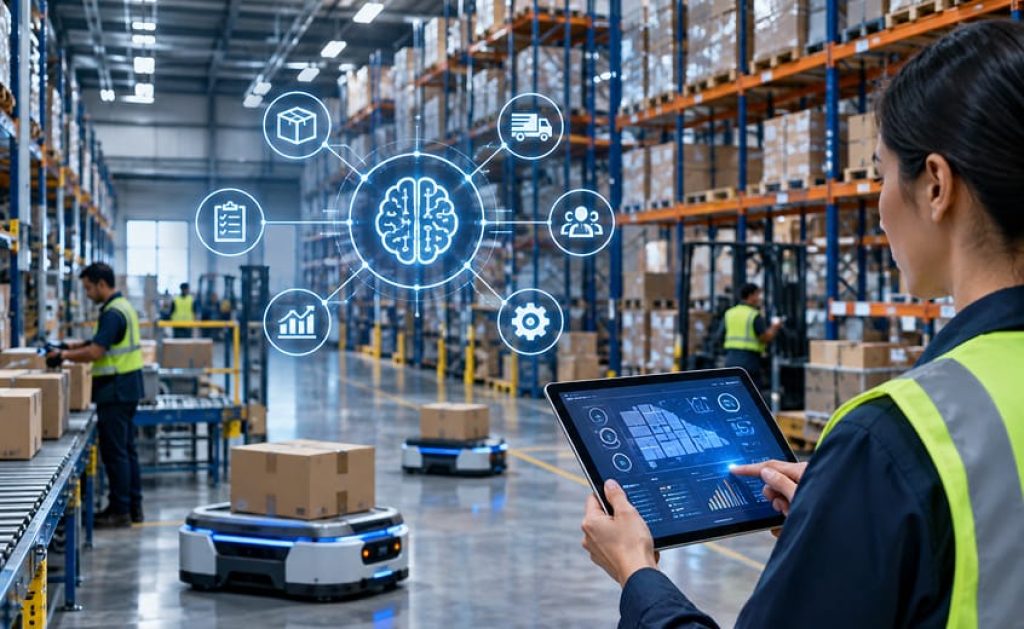
Improving warehouse performance requires more than executing individual tasks faster. It requires recognizing changing conditions and coordinating the right response before service, productivity, or cost is affected.
A delayed replenishment can slow picking. A labor shortage in one zone can jeopardize carrier cutoffs. An inventory discrepancy can disrupt multiple orders. Equipment downtime can create congestion throughout the facility.
Because warehouse processes are interconnected, a localized issue can quickly affect throughput, labor utilization, order accuracy, operating costs, and customer commitments.
Warehouse management systems have helped organizations standardize and automate many of these processes. But when conditions deviate from the plan, supervisors and managers may still need to gather information from multiple systems, assess the operational impact, determine the best response, and coordinate action across teams.
Agentic AI introduces the potential to shorten this decision-to-action cycle.
For warehouse leaders, this creates a growing opportunity to use agentic AI in warehouse management to improve operational decision-making, accelerate exception resolution, and coordinate increasingly complex warehouse operations.
Gartner predicts that by 2030, 50% of cross-functional supply chain management solutions will use intelligent agents to autonomously execute decisions across the supply chain ecosystem. This forecast indicates where the technology is heading, but it does not suggest that warehouses should pursue unrestricted autonomy. The more immediate opportunity is to apply controlled AI-driven decision support and execution to well-defined processes supported by reliable data, clear business rules, and appropriate human oversight. (Gartner, May 2025)
What Is Agentic AI in Warehouse Management?
Different forms of AI support different operational needs.
Traditional analytics helps warehouse leaders understand what happened. Predictive AI estimates what may happen next, allowing teams to anticipate changes in demand, inventory availability, equipment performance, and operating risk. Generative AI can summarize information, answer questions, and help employees complete individual tasks.
Agentic AI goes further by helping coordinate decisions and actions across a process.
An AI agent can monitor operating conditions, evaluate information from connected systems, determine or recommend a response, and initiate approved actions within established boundaries. Multiple agents may also coordinate across related processes, while employees retain control of sensitive, high-risk, or exceptional decisions.
Consider an order at risk of missing its carrier cutoff. Instead of simply alerting a supervisor, an agent could:
- Review the order’s status, priority, and remaining tasks.
- Verify available inventory and replenishment activity.
- Assess current labor and task capacity.
- Identify the likely cause of the delay.
- Recommend or initiate an approved action.
- Escalate the issue when human judgment is required.
The value is not simply a better alert. It is a faster, better-informed, and more coordinated response.
How Agentic AI Can Improve Warehouse Operations and Performance
The strongest initial use cases are not necessarily the most complex. They are typically recurring, measurable processes that consume significant supervisory time and operate within clearly defined business rules.
Four areas offer particularly relevant opportunities.
1. Accelerating Exception Resolution
Warehouse exceptions frequently require supervisors or planners to search across multiple screens, applications, and teams before they can determine what happened and what to do next.
Examples include:
- Inventory discrepancies
- Short picks
- Missed replenishments
- Delayed inbound receipts
- Damaged products
- Equipment interruptions
- Orders approaching carrier cutoffs
An intelligent agent could detect an exception, assemble the relevant information, assess its potential effect on fulfillment, and recommend a prioritized response.
If a replenishment is delayed, for example, the agent could identify affected orders, check inventory in alternate locations, evaluate approaching carrier cutoffs, and present the most appropriate response options. In a low-risk, predefined situation, it might initiate an approved action. If the decision has greater operational or customer consequences, it could escalate the issue with the relevant context already assembled.
The objective is to reduce the time between detecting an exception and resolving it—ideally before it affects throughput or customer service.
2. Improving Labor and Task Orchestration
Labor plans are typically established before a shift begins, but actual warehouse conditions rarely follow the plan precisely.
Order priorities change. Employees become unavailable. Work accumulates in one zone while capacity remains available elsewhere. Congestion increases travel time. Equipment interruptions affect task completion.
Supervisors must continually interpret these conditions and adjust labor deployment, task priorities, and work sequences.
Agentic AI could continuously evaluate:
- Order volume and priority
- Workforce availability
- Task queues and backlogs
- Zone productivity
- Aisle and staging congestion
- Equipment availability
- Carrier cutoff times
Based on established operating rules, an agent could detect an emerging imbalance, estimate its potential effect on throughput, and recommend changes to labor allocation or task sequencing.
Supervisors would remain responsible for employee safety, workforce decisions, and situations requiring experience or judgment. The agent’s role would be to recognize changing conditions sooner and evaluate possible responses more quickly.
3. Coordinating Orders, Inventory, and Replenishment
Order release, inventory allocation, and replenishment are closely connected, but they may be managed through separate workflows.
Planners must balance customer priorities, available inventory, labor capacity, order complexity, carrier schedules, dock capacity, and work already in progress. Fixed rules can automate parts of this process, but they may not adjust effectively as operating conditions change.
Agentic AI could continually reassess these conditions and recommend adjustments to:
- Order-release timing
- Order grouping and sequencing
- Replenishment priorities
- Inventory allocation
- Inbound receipt priorities
- Task dependencies
Infor’s April 2026 Industry AI release illustrates the broader direction of this technology. Infor expanded its Industry AI Agent library to more than 100 agents and enhanced its Agentic Orchestrator to coordinate agents across multistep workflows. The release also added connectivity with Infor and non-Infor systems and greater visibility into agent reasoning before production deployment.
These are broader enterprise and industry capabilities; organizations should confirm the availability, maturity, and warehouse applicability of individual agents before developing an implementation plan. (Infor, April 2026)
The direction is nevertheless significant: AI is progressing from isolated task assistance toward coordination across inventory, procurement, fulfillment, transportation, and other connected operations.
4. Identifying Operational Risk Earlier
Many warehouse problems develop gradually before they become visible through missed service commitments or increased operating costs.
Potential warning signs include:
- Declining productivity in a particular zone
- Growing replenishment backlogs
- Rising error or exception rates
- Increasing equipment downtime
- Congestion near staging or shipping areas
- Orders approaching service-level deadlines
- Recurring inventory discrepancies
A dashboard can display these conditions. An intelligent agent could help determine which situations require attention, assess their potential operational impact, and recommend preventive action.
This would not replace experienced warehouse leadership. It could provide earlier warning, more complete context, and more time to intervene.
How Agentic AI Complements the WMS
Agentic AI should not be viewed as a replacement for the warehouse management system.
The WMS remains the operational foundation for managing inventory, orders, labor, tasks, and warehouse workflows. It provides the structured processes, transaction history, and operational data that intelligent agents require.
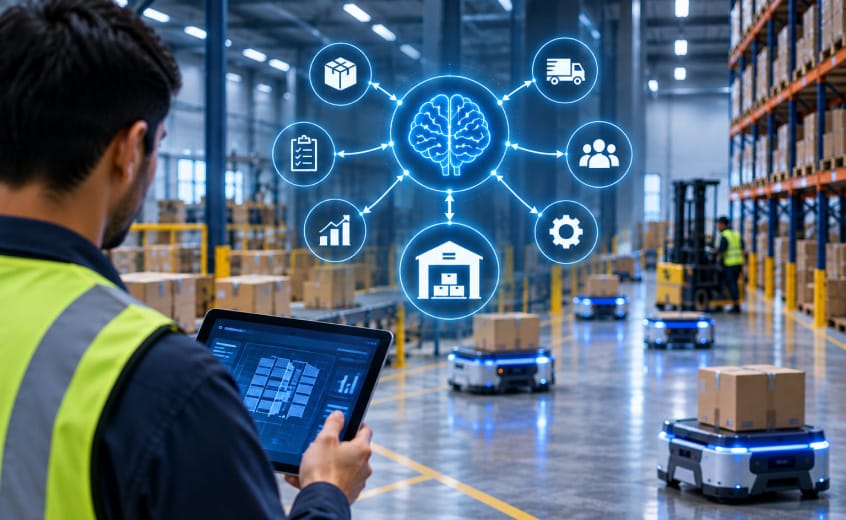
Agentic AI can build on that foundation by adding a layer of decision support and coordination. It can interpret current conditions, connect information across processes, recommend actions, and, in appropriately controlled situations, initiate predefined steps through the WMS and other connected systems.
The greatest value is therefore unlikely to come from deploying an AI agent in isolation. It will come from combining:
- A capable WMS
- Reliable and accessible operational data
- Connected warehouse and supply chain systems
- Clearly defined processes and decision rights
- Governed AI agents
- Effective workforce adoption
- Performance measures tied to business outcomes
The Main Barrier Is Not Access to AI
The rapid growth of agentic AI may create the impression that implementation is primarily a technology-selection exercise. In practice, system integration, operational readiness, governance, and internal expertise can present greater challenges.
In an October–November 2025 survey of 140 senior supply chain leaders at organizations with at least $250 million in annual revenue, Gartner found that 56% considered integrating AI with legacy systems and processes a major challenge. Half reported limited internal expertise or talent to implement and manage AI. (Gartner, April 2026)
For warehouse leaders, the implication is straightforward: access to AI does not create operational value by itself.
The technology must be connected to the systems where work occurs, grounded in reliable warehouse data, aligned with established operating processes, and governed according to the consequences of each decision.
How Warehouse Leaders Should Begin
Agentic AI initiatives should start with an operational problem—not with a goal of automating everything.
Warehouse leaders should ask:
- Which recurring exceptions consume the most supervisory time?
- Which decisions require employees to gather information from several systems?
- Which processes have clear rules and reliable supporting data?
- Which actions can be automated safely?
- Which decisions should require human review or approval?
- What integrations are necessary to provide sufficient operational context?
- How will recommendations, actions, escalations, and overrides be monitored?
- Which KPIs will demonstrate measurable value?
A strong initial use case should be frequent enough to matter, bounded enough to control, and measurable through established warehouse performance indicators.
Depending on the use case, relevant measures could include:
- Exception-resolution time
- Labor productivity
- Order-cycle time
- Fill rate
- Inventory accuracy
- On-time shipment performance
- Cost per order
- Supervisory time spent on manual investigation
Organizations can begin with decision support or low-risk actions and expand the agent’s authority only when performance, controls, and operational reliability justify doing so.
Turning Agentic AI into Measurable Warehouse Value
Successful implementation requires more than AI technology. It requires warehouse operations knowledge, WMS expertise, data readiness, systems integration, AI engineering, governance, and organizational change management.
This is where Delaplex can provide real business value.
Delaplex brings together supply chain consulting, WMS capabilities, automation, analytics, integration, digital engineering, and managed services. Its Infor practice combines Infor WMS capabilities with Delaplex’s experience in warehouse modernization, operational data, AI-driven analytics, and connected supply chain systems. (Delaplex and Infor; Delaplex Supply Chain Consulting)
That breadth enables Delaplex to help warehouse leaders address the complete implementation challenge by:
- Assessing warehouse processes, constraints, and technology readiness
- Identifying and prioritizing high-value use cases
- Establishing a measurable operational baseline
- Preparing data and connecting the WMS with required systems
- Defining business rules, decision rights, and escalation paths
- Designing appropriate human oversight and governance
- Implementing and testing agents within controlled workflows
- Supporting workforce adoption and operational change
- Measuring results and expanding capabilities where justified
The value of agentic AI will not be determined by the number of agents an organization deploys. It will be determined by whether those agents improve the outcomes that matter: throughput, productivity, accuracy, service, cost, and operational resilience.
Agentic AI will not eliminate the need for experienced warehouse leaders. Properly integrated and governed, it can help them detect issues earlier, evaluate situations faster, and coordinate increasingly complex operations with greater confidence.
Join Delaplex and Infor for the upcoming Lunch & Learn, The Next Generation of Warehouse Operations: Practical Strategies to Improve Warehouse Performance Through AI-Assisted Decision-Making. The session will examine how agentic AI complements a modern WMS, where it can create practical business value, and how warehouse leaders can prepare for more intelligent and connected operations.